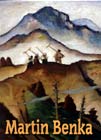
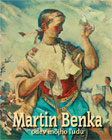
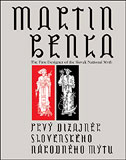
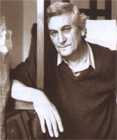
Martin Benka (1888 - 1971) is one of founders of the Slovak modern painting art. He was trained in post-Impressionist landscape painting but tended to the principles of decorativism and symbolism of Secession painting, he drew some inspiration also from the Expressionist principles.
Since the late 1920s he had focused almost exclusively on representation of the rural Slovakia and its mountainous landscape, by the 1930s he developed his signature and original monumental style but also created small-size intimate cabinet paintings, drawings, graphic art (graphic designs for postal stamps, banknotes, diplomas), book designs and illustrations. In addition, he wrote and published his memoirs, played several musical instruments and composed music.
Albin Brunovsky (1935 - 1997) was a painter and graphic artist. Each area of his creation - painting, illustration, graphics - became the jewel of the Slovak, as well as the world culture. Many awards at home and abroad testify this fact. Thanks to him, "Slovak Graphic School" started to be spoken of. He was one of the designers of Czechoslovak banknotes and stamps. His illustrations were primarily for children's books.
Brunovsky lectured at the Academy of Fine Arts in Bratislava from 1966 to 1990. In 1981 he was appointed a professor, creating his own engraving school several years later. Brunovsky's work often mirrored that of the modern movement, citation art.
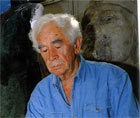
Tibor Bartfay (1922) is known as a bard of Slovak monumental sculpture. He has created more than 2000 sculptures, the last one is a sculpture of Hans Christian Andersen. You can see it at the Hviezdoslavovo Square in Bratislava. He studied at the Academy of Fine Arts in Budapest (1939-1942), under the guidance of professor Sidlo and at the Academy of Creative Arts in Prague (1945-1949) under professor Karel Pokorny.
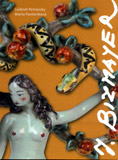
His paintings seem to resist any serious reflection and refuse to be bridled by aesthetic categories, judgements or evaluations. Guldan appears to be constantly playing in his pictures, particularly those dated from the patinated assemblage period (the technique he developed), curious to find what will come out from under his hands...
He takes new things into his hands with a surprised laugh, he turns them around, plays with them, combines shapes, he takes them to pieces and forms new ones...
"Who is Martin Jonas? To those who took at least a fleeting glimpse into even the briefest encyclopaedia of naiv art, this name should be well known. The name belongs to a man whose wealth of talent and aesthetic imagination ranks him among the most amazing personalities in the world of current naive art. He contributed significantly to the forming of the notable Kovacica naivist group," writes one of the authors monograph about Martin Jonas Ivan Melichercik.
Pavol Barabas makes films about his friends who has experienced something special. He is interested in the stories of people in an extreme environment which, as he put it, "shows what kind of person he really is," writes bulletin of the 7th International Film Festival Bratislava. His films have been received the attention of the audience not only at home, but primarily at numerous film festivals around the world.
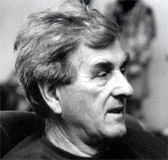
Je výraznou osobnosťou českej a slovenskej audiovizuálnej kultúry. Pochádza z východného Slovenska, narodil sa v Nižnej Šebastovej v prešovskom okrese. Po oceňovanom krátkometrážnom debute Diadém nakrútil niekoľko ďalších filmov, ktoré ho v 70. rokoch zaradili k vtedajším najväčším československým talentom: Tak som prešla veľký svet, Batromijov dom a Tam a späť (ocenený v roku 1990 ako najlepší čs. dokument z rokov 1969 - 1989). Režíroval niekoľko hraných a dokumentárnych filmov (Brehy nehy, Dedinský sen, Trate života Jozefa Kronera).
V roku 1984 nakrútil prvý autorský celovečerný hraný film Džúsový román, ktorý sa nesmel premietať a Fenič načas nemohol vykonávať filmárske povolanie. Až o päť rokov nakrútil druhý hraný film Zvláštne bytosti, ktorý prorokoval pád komunizmu, a medzinárodne ocenený krátky film Vlak do dospelosti. Tretí celovečerný film vytvoril v roku 1998 - bol to strihový film z populárnej českej televíznej relácie Česká soda.
Fenič je zakladateľom a riaditeľom nezávislej filmovej a televíznej spoločnost FEBIO, ktorá poriada medzinárodnú prehliadku filmu, televízie a videa FEBIOFEST.
V roku 1957 absolvoval odbor fotografie na Škole umeleckého priemyslu v Bratislave. Na prelome päťdesiatych a šesťdesiatych rokov podnietil vznik niekoľkých projektov (Divadlo obrazu, Štúdio) a sústredil okolo seba skupinu mladých umelcov z rôznych disciplín. Sám Havetta bol prozaikom, aranžérom, fotografom, výtvarným redaktorom, knižným grafikom..., no od prijatia na FAMU v roku 1961 sa stala pre neho prvoradou filmová tvorba...
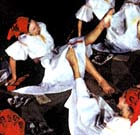
Slovak folklore is rich and various. Folk customs and traditions vary among themselves according to geographic region. An important part of the folk culture is folklore that is retained in spoken, musical, dramatic and dance forms as well as in traditional architecture and handicrafts.
Most famous folk ensembles are SLUK and Lucnica that present Slovak folklore also abroad. Every year, several folklore festivals take place, the biggest (except 2006) being in town Vychodna.
The Slovak Folk Art Ensemble - SLUK, performs Slovak music and dance. Folk traditions from all over Slovakia are represented in unique arrangements. SLUK has performed around the world.
The Slovak National Folklore Ballet – Lucnica spreads its art for more than 58 years in countries all around the world. The dance ensemble is accompanied with an orchestra which is a small professional group of excellent musicians named Golden Violin. The Lucnica Chorus is known for its advanced singing technique as well as for the vocal culture.
"Song maintains the language," says Slovak ethnomusicologist Ondrej Demo More...